Mansa Musa reaches Cairo曼萨·穆萨到达开罗
ZHANHISTORYSUPER CLASSROOM
KINGDOMS & EMPIRES王国与帝国:非洲与美洲
G8 · UNIT 1 · CHAPTER 1
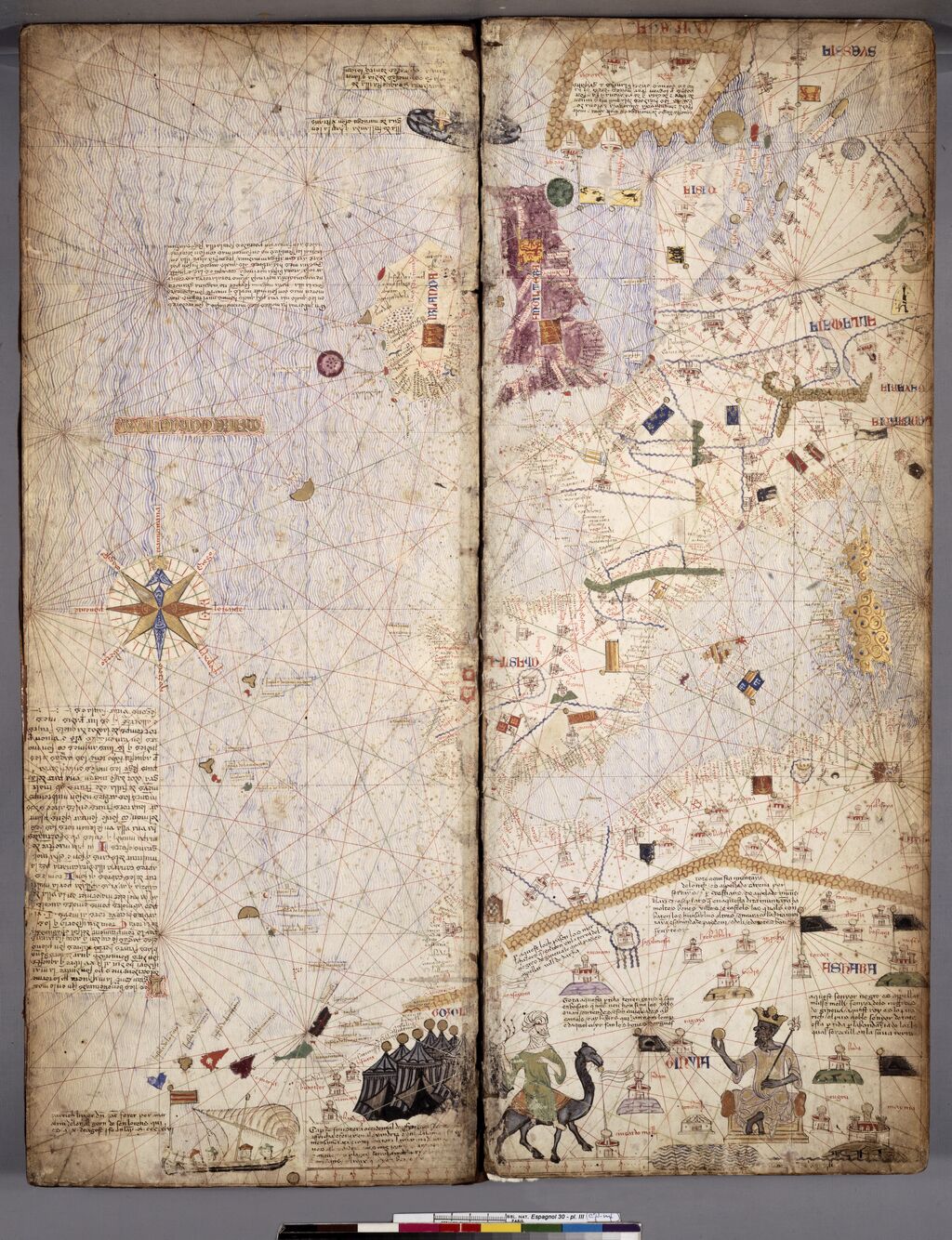
CATALAN ATLAS · c. 1375 · BIBLIOTHÈQUE NATIONALE DE FRANCE
LESSON MAP · 学习地图
Ibn Battuta visits Kilwa伊本·白图泰到访基尔瓦
Catalan Atlas is created《加泰罗尼亚地图集》制作
Triple Alliance forms三方联盟形成
Columbus enters the Caribbean哥伦布进入加勒比
War for Tenochtitlan特诺奇蒂特兰战争
Big Question本课问题
How did different civilizations build power before European expansion?
欧洲扩张之前,不同文明如何建立权力?
Lesson Thesis本课论点
Before European expansion, societies in Africa, the Americas, and the Caribbean built institutions adapted to local resources, trade, labor, belief, and environment, showing that state power had no single formula.
欧洲扩张之前,非洲、美洲和加勒比社会根据本地资源、贸易、劳役、信仰与环境建立不同权力制度,说明国家权力没有唯一模式。
LESSON TOOLKIT · 课前工具
Vocabulary, questions and thesis frames · 词汇、问题与论点框架
01Core Vocabulary核心词汇+
A large state that controls many peoples, regions, or communities.
控制多个民族、地区或社群的大型国家。
An independent city with its own government and surrounding territory.
拥有独立政府及周边领土的城市。
Goods, labor, or people demanded from conquered or weaker groups by a stronger ruler.
被征服或较弱群体向更强统治者缴纳的物品、劳役或人口。
The spread and blending of ideas, beliefs, languages, goods, or technologies between societies.
思想、信仰、语言、商品或技术在不同社会之间传播并融合。
The way people adapt to, change, or are limited by their physical environment.
人类如何适应、改变自然环境,或受到自然环境限制。
Labor service that required Andean communities to provide workers to the state.
安第斯社群按要求为国家提供劳动力的制度。
An Inca record made with colored cords and knots, especially for numbers and obligations.
印加用彩色绳索和绳结记录数字与义务的工具。
A local Taíno leader who coordinated community affairs.
负责协调泰诺地方社群事务的首领。
02Core Questions核心问题目录+
Core Questions
- How did West African kingdoms turn trade into state power?
- How did Swahili city-states use ocean trade to build wealth and culture?
- Why did Aztec power depend on tribute, warfare, and adaptation to Lake Texcoco?
- How did Inca rulers hold together a mountain empire without coin money or alphabetic writing?
- What patterns of power can we compare across societies in Africa, the Americas, and the Caribbean before European expansion?
03Comparison Frame比较框架+
Mali and Songhai马里与桑海
Southern edge of the Sahara and trans-Saharan routes
撒哈拉南缘与跨撒哈拉路线
Gold-salt trade and caravan taxes
黄金-食盐贸易与商队税收
Swahili city-states斯瓦希里城邦
East African coast and Indian Ocean routes
东非海岸与印度洋路线
Port trade and customs duties
港口贸易与关税
Aztec Empire阿兹特克帝国
Lake Texcoco and central Mexico
特斯科科湖与墨西哥中部
Tribute and chinampa farming
贡赋与奇南帕农业
Inca Empire印加帝国
Andes Mountains
安第斯山脉
Mit'a labor, storehouses, redistribution
mit'a 劳役、仓储、再分配
Taino societies泰诺社会
Caribbean islands
加勒比岛屿
Cassava farming, fishing, exchange
木薯农业、捕鱼、交换
04Exam Thesis Bank核心论点参考+
Exam Thesis Bank
- Before European expansion, societies built power through trade, tribute, labor, belief, and environmental adaptation.
- Mali and Songhai show how rulers could turn trade wealth into taxation, prestige, and Islamic connections.
- Swahili city-states show how port cities used Indian Ocean trade to gain wealth and cultural influence.
- Aztec and Inca power depended on different systems: tribute and warfare in Mexico, labor and infrastructure in the Andes.
SECTION 01 · 第 01 节
Mali & Songhai马里与桑海
Section 1 - How did West African kingdoms turn trade into state power?
第一问 - 西非王国如何把贸易转化为国家权力?
Cairo, 1324 — Mansa Musa travels from Mali to Mecca1324 年,开罗——曼萨·穆萨从马里前往麦加
Historical Setting
- Time: c. 1324-1337, during the reign of Mansa Musa of Mali.
- Place: Cairo, a major city on Mali's pilgrimage route to Mecca.
- Story Viewpoint: Mali's ruler Mansa Musa arriving in Cairo during his pilgrimage.
- Key Background: Mali stood near gold-producing regions and major trans-Saharan caravan routes.
Personal Story
In 1324, Mansa Musa entered Cairo while traveling from Mali to Mecca. His large party needed food, animals, lodging, and supplies for the next stage of the pilgrimage. Musa also met the Mamluk sultan's court, gave royal gifts, and distributed gold. Each action presented him not as an unknown traveler from beyond the Sahara, but as the Muslim ruler of a wealthy state.
The display rested on institutions far from Cairo. Mali controlled territory near major goldfields and taxed caravans moving through its lands. Officials protected routes, governed cities, and converted trade revenue into soldiers, administration, and court wealth. The pilgrimage showed what that system could support: a ruler and royal household crossing the Sahara while maintaining diplomatic standing in one of the Islamic world's largest cities.
Generous spending brought consequences Musa could not fully control. Later reports said that so much gold entered Cairo's market that its local value fell for years, although exact amounts remain uncertain. More lasting was the change in Mali's reputation. Merchants, officials, and writers now connected West African gold with a named ruler and empire. Trade wealth had become visible political power.
小故事
1324 年,曼萨·穆萨从马里前往麦加朝觐,途中进入开罗。庞大的随行队伍需要食物、牲畜、住处和下一段旅程的补给。穆萨还与马穆鲁克苏丹的宫廷往来,赠送王室礼物并分发黄金。他让开罗看到的不是一位来自撒哈拉以南的普通旅人,而是一位富裕穆斯林国家的统治者。
这场展示依靠远在开罗之外的制度。马里控制靠近重要金矿的土地,也向经过领地的商队征税。官员保护路线、管理城市,再把贸易收入转化为军队、行政和王室财富。朝觐让这些制度的力量集中呈现:国王与宫廷能够穿越撒哈拉,并在伊斯兰世界的重要城市维持外交地位。
慷慨用金也带来穆萨无法完全控制的结果。后来的记载说,大量黄金进入开罗市场后,当地金价多年受到影响,虽然具体数量难以确定。更持久的变化发生在马里的声望上。商人、官员和作者开始把西非黄金同一位有名字的国王及其帝国联系起来。贸易财富由此成为外界能够看见的政治力量。
Real History
Mansa Musa's 1324-1325 pilgrimage survives mainly through Arabic accounts written from reports rather than a diary by Musa himself. Al-Umari interviewed people who had seen the court in Cairo and described both its gold and the later fall in gold's local value. Exact caravan numbers vary, but the economic reaction and diplomatic attention are well established. After returning, Musa supported Islamic building and scholarship. Timbuktu's mosques and manuscript tradition show how Mali's commercial wealth could strengthen religion, education, administration, and international prestige at the same time.
Further Reading
- Mansa Musa in the Catalan Atlas (1375) — Illuminated map, Bibliothèque nationale de France. Reading focus: Examine Mansa Musa's crown, gold object, and position beside trans-Saharan routes, then compare this European image with Arabic reports of his pilgrimage.
扩展阅读
- 《加泰罗尼亚地图集》中的曼萨·穆萨(1375) —— 彩绘地图,法国国家图书馆。导读:观察曼萨·穆萨的王冠、手中金块和他在跨撒哈拉路线旁的位置,再把这幅欧洲图像与阿拉伯作者对其朝觐的记载对照。
Core Concepts
- West African kingdoms could build power by controlling trade routes and taxing the movement of gold, salt, and other goods.
- Mansa Musa's pilgrimage shows that Mali's trade wealth became known across the wider Islamic world.
- Timbuktu and other cities show how trade wealth could support scholarship, mosques, law, and diplomacy.
- The conceptual chain is trade routes -> taxation -> protected commerce -> royal wealth -> political authority and cultural prestige.
SECTION 02 · 第 02 节
Swahili coast斯瓦希里海岸
Section 2 - How did Swahili city-states use ocean trade to build wealth and culture?
Kilwa Kisiwani, 1331–1332 — Ibn Battuta arrives by sea1331—1332 年,基尔瓦——伊本·白图泰从海上抵达
Historical Setting
- Time: 1331, when Kilwa was a major Swahili trading city.
- Place: Kilwa Kisiwani on the East African coast.
- Story Viewpoint: North African traveler Ibn Battuta arriving at Kilwa.
- Key Background: Kilwa was an independent port where African and overseas merchants met.
Personal Story
When Ibn Battuta reached Kilwa in 1331, he entered the city from the sea. He had already traveled through many Indian Ocean ports, so he knew what a busy commercial city looked like. Kilwa impressed him. Coral-stone buildings rose near the shore, Muslim worship shaped public life, and the ruler received visitors within a court supported by trade.
Ships reached Kilwa by following seasonal monsoon winds. Merchants carried goods from the African interior to the coast, while imported cloth and ceramics arrived through several stages of exchange. The city's rulers did not command one vast East African empire. Their influence depended on protecting the harbor, collecting duties, and keeping Kilwa useful to merchants who could sail elsewhere. In markets and mosques, Ibn Battuta could also hear a coastal language rooted in African Bantu speech but enriched by centuries of contact with Arabic-speaking merchants. Religious and commercial ties reinforced one another at the port.
Ibn Battuta later praised Kilwa in his travel account. His description preserved the view of a wealthy African city whose power came from the sea.
Real History
Ibn Battuta's account describes Kilwa as a prosperous Muslim city and records his meeting with its ruler. Archaeology adds evidence the traveler could not preserve in words. At Kilwa Kisiwani, the Great Mosque, the palace complex of Husuni Kubwa, local coins, and imported ceramics point to concentrated wealth and long-distance exchange. Chinese and Persian wares may have passed through several merchants before reaching East Africa; they still confirm that Kilwa belonged to an Indian Ocean network extending far beyond its harbor.
Further Reading
- "Ruins of Kilwa Kisiwani and Ruins of Songo Mnara" — Historic site, UNESCO. Reading focus: Explore the Great Mosque, Husuni Kubwa, coins, and imported ceramics as evidence of Indian Ocean trade.
扩展阅读
- 联合国教科文组织“基尔瓦基斯瓦尼与松戈姆纳拉遗址” —— 历史遗址,联合国教科文组织。导读:可从大清真寺、胡苏尼库布瓦宫、钱币和进口陶瓷观察印度洋贸易留下的证据。
Core Concepts
- Swahili city-states were independent coastal trading cities, not one unified empire.
- Kilwa's port connected inland African goods with merchants across the Indian Ocean.
- Swahili culture reflects cultural diffusion because African, Arab, Persian, and Islamic influences blended in language, religion, architecture, and trade.
- The conceptual chain is monsoon trade -> port control -> merchant trust -> wealth -> cultural diffusion.
SECTION 03 · 第 03 节
Aztec capital阿兹特克首都
Historical Setting
- Time: Early 1500s, before the Spanish entered Tenochtitlan in 1519.
- Place: Tenochtitlan on Lake Texcoco in central Mexico.
- Story Viewpoint: A chinampa farmer paddling his harvest into the city.
- Key Background: Tenochtitlan's island location made dependable food supplies essential.
Personal Story
Before sunrise, a farmer loaded maize, beans, and flowers from a chinampa into a canoe. The raised field drew moisture from the lake environment, but it still required careful digging, planting, and maintenance. Canals carried the harvest toward Tenochtitlan faster than an overland cart could move through crowded causeways.
At the capital's market, the farmer entered a much larger flow of goods. Porters delivered cotton cloth, cacao, feathers, and warrior clothing demanded from conquered communities. Some supplies went to markets; others entered imperial storehouses or supported rulers, priests, and warriors. The island city depended on nearby agriculture and on wealth drawn from farther away.
The two systems carried different pressures. A poor chinampa harvest threatened daily food supplies. A missing tribute payment challenged political obedience. Local rulers might remain in office after conquest, but repeated refusal could bring punishment or another campaign. Tenochtitlan's strength came from joining environmental adaptation to military power. The same tribute system that enriched the capital also gave resentful subject communities reasons to resist Aztec rule.
小故事
天刚亮,一位农民便沿运河划向特诺奇蒂特兰。独木舟里装着刚从奇南帕收获的玉米、豆类和鲜花。湖中围垦出的狭长田地土壤肥沃,却需要不断清理水道、加固边缘。对他来说,首都每天的食物供应来自湖上持续不断的劳动。
靠近市场时,水面和堤道越来越拥挤。另一批搬运者正把棉布、可可、羽毛和战士服装送往仓库。这些并不是湖边农田的收成,而是被征服社群必须定期缴纳的贡赋。农民出售作物换取所需物品;贡赋队伍却在履行帝国规定的义务。若某地拖欠或反抗,阿兹特克统治者可能再次派出军队。
两股物资在首都汇合,却承受着不同压力。奇南帕农业让人口密集的湖中城市获得稳定食物,军事征服则把远方财富集中到特诺奇蒂特兰。城市因此更加繁荣,统治者也能供养军队并举行大型仪式。不过,被征服社群付出的代价同样真实。1519 年以后,一些群体选择与西班牙入侵者结盟,贡赋统治积累的怨恨是原因之一,但疾病、武器和政治冲突也共同影响了帝国的覆灭。
Real History
The Codex Mendoza preserves the clearest surviving picture of Aztec tribute. Created in the early 1540s with Indigenous knowledge and pictorial traditions, it lists conquered provinces and regular deliveries to imperial rulers. This system supported the Triple Alliance led by Tenochtitlan, Texcoco, and Tlacopan; local rulers often remained in place as long as tribute arrived. Archaeology and early colonial descriptions document chinampa zones south of the capital, where canals and raised fields supplied dense urban markets. Food production sustained the city, while tribute turned military victory into repeated political income.
Further Reading
- Codex Mendoza, MS. Arch. Selden A. 1 — Digital manuscript, Bodleian Libraries, University of Oxford. Reading focus: Examine the tribute pages to see how conquered provinces and required goods were recorded.
扩展阅读
- 牛津大学博德利图书馆《门多萨手抄本》MS. Arch. Selden A. 1 —— 数字手稿,牛津大学博德利图书馆。导读:可查看贡赋页,辨认被征服地区和定期上缴物品的记录方式。
Core Concepts
- The Aztec adapted to Lake Texcoco through chinampas, causeways, and urban engineering.
- Regular tribute transferred goods from conquered communities to the capital, army, and ruling elite.
- Warfare, tribute, and religion reinforced one another in Aztec rule.
- The conceptual chain is conquest -> tribute demands -> wealth and display -> resentment and vulnerability.
SECTION 04 · 第 04 节
Inca Andes印加安第斯
Historical Setting
- Time: c. 1438-1532, before the Spanish conquest of the Inca Empire.
- Place: An Inca road in the Andes.
- Story Viewpoint: A chaski runner carrying an order between state storehouses.
- Key Background: Mountain distances made the movement of messages and supplies a constant challenge.
Personal Story
High in the Andes, a chaski runner received a message at a roadside station and started along his assigned section of the Inca road. He did not run across the entire empire. At the next relay point, another runner would carry the information onward, allowing news to move much faster than one traveler could manage alone. Nearby tambos supported official travelers with shelter and supplies.
The route crossed steep slopes and a rope bridge above a gorge. Workers supplied through the mit'a labor system maintained roads, bridges, terraces, and relay stations. Without that labor, the runner's speed would mean little; a broken bridge could stop an imperial order.
At an administrative center, the message directed officials to release dried potatoes, maize, and cloth from a qollqa storehouse. A quipu specialist checked the quantities stored and distributed. No coins or alphabetic document were required. Human relays moved instructions, knotted records tracked numbers, and warehouses held supplies produced through organized labor. The runner's short journey was one link in a system connecting distant communities to Cusco.
小故事
一位 chasqui 信使沿安第斯山路奔跑,手中的口信要求前方仓库为一支经过的军队准备补给。到达接力点后,他把消息交给下一位信使。对方立刻出发,沿铺设好的道路跑向更高处的行政中心。山谷、陡坡和寒冷不会消失,但接力让命令不必由一个人走完全程。沿途的 tambo 驿站还能为公务旅行者提供休息处和补给。
消息抵达 qollqa 国家仓库后,管理人员取出脱水马铃薯、玉米和布料,并请 quipu 专员核对结绳记录。这里没有铸币工资。附近社群通过 mit'a 劳役修路、维护绳桥、耕种国家土地,也为仓库和军队提供服务。国家再把劳动成果调往需要的地区。
信使继续前进时,脚下道路本身已经说明这套制度如何运转。驿站提供休息和补给,绳桥跨越峡谷,梯田扩大不同海拔的耕地。任何一环都可能造成麻烦:桥梁损坏会拖慢消息,仓库短缺会使军队无法行动,错误记录则会让官员误判物资。印加统治者没有依靠货币或字母文字,而是把劳役、道路、仓储和结绳记录组织成一套相互配合的山地治理系统。
Real History
Surviving quipu preserve physical evidence of Inca record keeping. Their cords and knots recorded numbers, while Spanish colonial accounts describe officials using such records for population, labor, tribute, and warehouse information. The Qhapaq Ñan road network connected administrative centers, warehouses, and roadside stations. Records could travel along these roads with officials, runners, workers, and supplies. Together, knotted records and roads allowed the Inca state to govern a difficult Andean landscape without alphabetic writing or coin money.
Further Reading
- Quipu — Museum object, British Museum. Reading focus: Enlarge the object and examine how knots, spacing, and differently colored cords could organize numerical records in the Inca Empire.
Core Concepts
- The Inca used centralized government and mit'a labor service to control a large mountain empire.
- Quipu allowed Inca officials to track quantities and obligations without alphabetic writing.
- Roads, chasqui runners, qollqa storehouses, and terraces helped solve problems of distance, altitude, food supply, and communication.
- The conceptual chain is state labor -> infrastructure -> storage -> record keeping -> imperial control.
SECTION 05 · 第 05 节
Taíno Caribbean泰诺加勒比
Historical Setting
Personal Story
Before sunrise on a Caribbean island, a Taino woman grated cassava while other villagers pressed out its bitter liquid and prepared bread for drying. Near the shore, canoe crews loaded food and crafted goods for exchange with another island. These journeys carried news as well as supplies.
The village cacique coordinated work, exchange, and ceremonies. Authority was close enough to be seen in the distribution of food and the gathering of families, yet the community was linked to settlements beyond its own shore. Farmers, fishers, craftspeople, and canoe travelers supported a society with its own political and spiritual life. Cassava was especially valuable because properly processed bread could be stored for journeys. Ceremonial objects associated with zemi spirits connected leadership and daily work to ancestors and sacred power. Community plazas created shared spaces for ceremony, decision-making, and public gatherings.
Later, unfamiliar sails appeared offshore. The people watching them were not standing in an empty or unorganized world. The newcomers were approaching communities already connected by farming, leadership, ritual, and travel across the Caribbean Sea.
小故事
加勒比一座岛屿上,天还没亮,一位泰诺妇女已经开始磨碎木薯。其他村民把木薯汁液压出,再把它制成便于保存的面饼。海岸边,独木舟船员装上食物和手工制品,准备前往另一座岛屿交换。这样的航行也会带回远方的消息。
村里的 cacique 首领负责协调劳动、交换和仪式。他的权威体现在食物如何分配、家庭如何聚集,也延伸到本岛以外的往来。农民、渔民、工匠和独木舟船员,共同维持着这个拥有政治生活和信仰传统的社会。木薯经过正确加工后可以长期储存,适合跨岛航行。与 zemi 神灵有关的仪式物品,把日常劳动和首领权威连接到祖先与神圣力量;村落广场则用于仪式、商议和公共聚会。
后来,海面上出现了陌生的船帆。岸边的人并不是生活在一片空白而混乱的土地上。外来者即将接触的,是一个已经依靠农业、首领权威、仪式和跨岛航行组织起来的加勒比世界。
Real History
Archaeological sites across the Caribbean contain griddles and other tools used to process cassava, along with pottery, shell ornaments, and ritual objects often called zemi. These remains document farming, skilled craftwork, and ceremonial life before European rule. Columbus's 1492 journal, preserved in a later summary by Bartolome de las Casas, also records canoes, exchange, and repeated European questions about gold. Because that account presents a European viewpoint, it cannot speak for Taino thoughts, but it confirms that Europeans entered inhabited and organized island societies. Taino authority operated on a smaller scale than the Aztec or Inca empires, yet it still organized food, ritual, leadership, and movement between communities.
Further Reading
- Taíno Zemí Figure (1200-1500 CE) — Stone sculpture, The Metropolitan Museum of Art. Reading focus: Examine the figure's posture, widened eyes, and platform, then connect ceremonial art with spiritual and political authority in Taíno communities.
扩展阅读
- 泰诺泽米雕像(1200-1500 年) —— 石雕,大都会艺术博物馆。导读:观察雕像的姿势、睁大的眼睛和顶部平台,再思考仪式艺术怎样连接泰诺社会的信仰与政治权威。
Core Concepts
- Different societies built power through different combinations of trade, tribute, labor, leadership, belief, and environmental adaptation.
- Taino evidence reminds historians that organized power did not always take the form of a large empire.
- Local chiefdoms and large empires differed in scale, but both organized labor, resources, and political loyalty.
- The conceptual chain is shared problem -> different environment -> different institution -> different pattern of power.
FIVE SOCIETIES · ONE COMPARATIVE QUESTION · 五个社会 · 一个比较问题
Power had no single formula.
权力从来不只有一种组织方式。LESSON HOMEWORK · 本课作业
Turn the lesson into evidence, comparison, and argument.
把本课知识转化为证据、比较与论点Complete all five Sections to generate the lesson homework.完成五个 Section 后解锁本课作业。
©Copyright · 版权所有Open the copyright notice and citation information · 点击查看版权与引用方式+
版权所有 / Copyright
Author: Monu Zhan (Dr. Zhan's AP History/ Dr. Zhan's BASIS History)
Copyright Notice: The textual creation, knowledge organization, source integration, question design, and framework design of this handout and all accompanying materials are original compilations. They are for internal study by students enrolled in this course only. Without the author's written consent, they may not be copied, distributed, dismantled, or used for online sales, institutional lesson-preparation sharing, any other commercial profit-making activities, or pirated distribution.
Citation: Please cite as "Dr. Zhan's Original History Materials."
作者: 詹墨奴(詹博士AP历史奇谈 / 詹博士讲贝赛思历史)
版权声明: 本讲义与所有配套材料的文字创作、知识梳理、史料整合、题目编排、框架设计均为原创整理。仅限本课程学员内部学习使用。未经作者书面同意,不得复制、传播、拆解用于线上售卖、机构备课共享等其他任何商业盈利行为或盗版传播行为。
引用请标注: 詹博士历史原创
版权所有 / Copyright
Author: Monu Zhan (Dr. Zhan's AP History/ Dr. Zhan's BASIS History)
Copyright Notice: The textual creation, knowledge organization, source integration, question design, and framework design of this handout and all accompanying materials are original compilations. They are for internal study by students enrolled in this course only. Without the author's written consent, they may not be copied, distributed, dismantled, or used for online sales, institutional lesson-preparation sharing, any other commercial profit-making activities, or pirated distribution.
Citation: Please cite as "Dr. Zhan's Original History Materials."
作者: 詹墨奴(詹博士AP历史奇谈 / 詹博士讲贝赛思历史)
版权声明: 本讲义与所有配套材料的文字创作、知识梳理、史料整合、题目编排、框架设计均为原创整理。仅限本课程学员内部学习使用。未经作者书面同意,不得复制、传播、拆解用于线上售卖、机构备课共享等其他任何商业盈利行为或盗版传播行为。
引用请标注: 詹博士历史原创
 微信号: zhanhistory